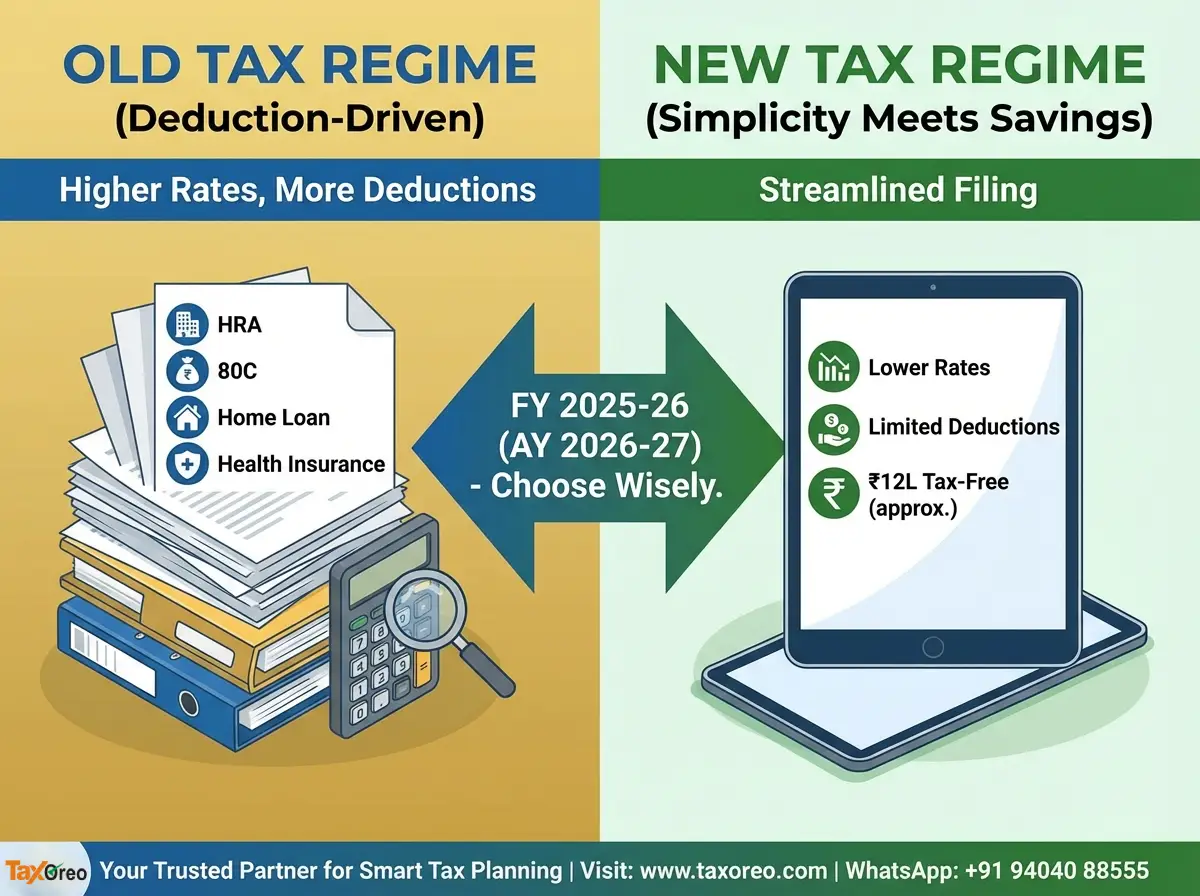
Old vs New Tax Regime For Salary 2026: Your Complete Guide to Smart Tax Planning
As we step into Tax Year 2026-27 (effective April 1, 2026), Indian taxpayers face one of the most significant tax planning decisions in recent years. Whether you're a salaried professional, business owner, freelancer, or retiree, choosing the wrong regime could cost you thousands of rupees in avoidable taxes. This comprehensive guide breaks down everything you need to know, with real calculations, practical examples, and expert insights to help you make the right choice.
Quick Tip: The right regime depends entirely on YOUR financial situation not what your colleague or social media influencer recommends.
Understanding the Two Tax Regimes
The Old Tax Regime: Deduction-Driven Planning
The Old Tax Regime follows a traditional approach: lower your taxable income through approved investments and expenses.
Key Features:
- Higher base tax rates across income slabs
- Access to 70+ deductions and exemptions under various sections
- Requires documentation and proof of investments/expenses
- Standard deduction of ₹50,000 for salaried employees
- Basic exemption limit: ₹2.5 lakh (for individuals below 60 years)
Best For: Taxpayers with substantial investments in ELSS, PPF, home loans, health insurance, HRA claims, and other deductible expenses.
The New Tax Regime: Simplicity Meets Savings
Introduced in Budget 2020 and made the default regime from FY 2023-24, the New Tax Regime prioritizes simplicity with lower rates and minimal paperwork.
Key Features:
- Significantly reduced tax rates across most income brackets
- Very limited deductions allowed (streamlined compliance)
- Higher standard deduction: ₹75,000 for salaried employees
- Section 87A Rebate: Up to ₹60,000, making income up to ₹12 lakh effectively tax-free
- Effective tax-free income: ₹12.75 lakh for salaried individuals (₹12L + ₹75K standard deduction)
Best For: Taxpayers with minimal investments, those who prefer hassle-free filing, or individuals whose deductions don't exceed the break-even threshold.
Tax Slab Comparison: FY 2025-26 (AY 2026-27)
New Tax Regime Slabs (Default Option)
|
Income Range (₹) |
Tax Rate |
Tax Payable (Cumulative) |
|
0 – 4,00,000 |
0% |
₹0 |
|
4,00,001 – 8,00,000 |
5% |
₹20,000 |
|
8,00,001 – 12,00,000 |
10% |
₹60,000 |
|
12,00,001 – 16,00,000 |
15% |
₹1,20,000 |
|
16,00,001 – 20,00,000 |
20% |
₹2,00,000 |
|
20,00,001 – 24,00,000 |
25% |
₹3,00,000 |
|
Above 24,00,000 |
30% |
As applicable |
Plus: 4% Health & Education Cess on total tax
Old Tax Regime Slabs (Individuals <60 Years)
|
Income Range (₹) |
Tax Rate |
Tax Payable (Cumulative) |
|
0 – 2,50,000 |
0% |
₹0 |
|
2,50,001 – 5,00,000 |
5% |
₹12,500 |
|
5,00,001 – 10,00,000 |
20% |
₹1,12,500 |
|
Above 10,00,000 |
30% |
As applicable |
Plus: Standard Deduction ₹50,000 + Section 87A Rebate up to ₹12,500
Deductions & Exemptions: The Critical Difference
Allowed in NEW Regime (Limited List)
- Standard Deduction: ₹75,000 for salaried employees & pensioners
- Employer's NPS Contribution: Under Section 80CCD(2)
- Interest on Let-Out Property: Section 24(b) (not self-occupied)
- Family Pension Deduction: ₹25,000 or 1/3rd of pension, whichever is lower
- Senior Citizen Interest Exemption: Section 80TTB up to ₹50,000
Allowed in OLD Regime (Extensive Benefits)
Section 80C (Up to ₹1.5 Lakh)
- EPF, PPF, ELSS Mutual Funds, Life Insurance Premiums
- Tuition Fees, Home Loan Principal Repayment
- NSC, 5-Year FDs, Sukanya Samriddhi Yojana
Section 80D: Health Insurance
- ₹25,000 for self/family + ₹25,000 for parents
- Additional ₹25,000 if parents are senior citizens
- Maximum benefit: ₹1,00,000
Section 24(b): Home Loan Interest
- Self-occupied property: Up to ₹2,00,000 deduction
- Let-out property: No upper limit
House Rent Allowance (HRA)
- Exemption based on: (a) Actual HRA received, (b) 50% of salary (metro) / 40% (non-metro), (c) Rent paid minus 10% of salary
Other Key Deductions:
- Section 80CCD(1B): Additional ₹50,000 for NPS
- Section 80E: Education loan interest (no upper limit)
- Section 80G: Donations to charitable institutions
- Section 80TTA: ₹10,000 for savings account interest
- Leave Travel Allowance (LTA), Professional Tax, and more
Real-World Scenarios: Which Regime Saves You More?
Scenario 1: Young Professional (Minimal Investments)
Profile: Age 28, Salary ₹10 LPA, Lives in rented accommodation, EPF contribution only (₹50,000)
|
Regime |
Taxable Income |
Tax Liability |
Verdict |
|
New |
₹9.25L (after ₹75K std deduction) |
₹33,800 |
WINNER |
|
Old |
₹9.5L (after ₹50K std deduction) |
₹91,000 |
Savings with New Regime: ₹57,200
Why? With minimal deductions, the lower slab rates of the New Regime easily outperform the Old Regime.
Scenario 2: Mid-Career Professional with Family Commitments
Profile: Age 38, Salary ₹18 LPA, Rent ₹30K/month, Investments: 80C (₹1.5L), Health Insurance (₹55K), Home Loan Interest (₹2L)
|
Regime |
Deductions Claimed |
Taxable Income |
Tax Liability |
Verdict |
|
Old |
₹6.95L (HRA+80C+80D+Home Loan) |
₹11.05L |
₹1,36,240 |
WINNER |
|
New |
₹75K (Standard only) |
₹17.25L |
₹2,14,760 |
Savings with Old Regime: ₹78,520
Why? Substantial deductions significantly reduce taxable income, making the Old Regime more beneficial despite higher slab rates.
Scenario 3: Senior Citizen with Pension Income
Profile: Age 67, Pension ₹7 LPA, Interest Income ₹2L, Health Insurance ₹50K
|
Regime |
Taxable Income |
Tax Liability |
Verdict |
|
New |
₹8.25L (after std deduction + senior benefits) |
₹19,500 |
WINNER |
|
Old |
₹8.5L |
₹52,000 |
Savings with New Regime: ₹32,500
Why? The New Regime's higher standard deduction and lower rates benefit seniors with moderate deductions.
The Break-Even Analysis: When Should You Switch?
Here's approximately how much in total deductions you need for the Old Regime to beat the New Regime:
|
Annual Income |
Minimum Deductions Needed for Old Regime to Win |
|
₹8-10 Lakh |
₹2.0 - 2.5 Lakh |
|
₹10-15 Lakh |
₹2.5 - 3.75 Lakh |
|
₹15-20 Lakh |
₹3.75 - 5.0 Lakh |
|
₹20-25 Lakh |
₹5.0 - 7.0 Lakh |
|
₹25 Lakh+ |
₹7.0 Lakh+ |
Pro Tip: Add up ALL your potential deductions (HRA + 80C + 80D + Home Loan Interest + NPS + Professional Tax + etc.). If your total exceeds the threshold for your income level, the Old Regime will likely save you more tax.
How to Switch Between Regimes: Step-by-Step
For Salaried Employees Flexible
- Good News: You can switch regimes EVERY financial year
- How to Switch:
- Inform your employer early via Form 12BB for correct TDS deduction
- When filing ITR (ITR-1 or ITR-2), select your preferred regime in the return form
- No special application required
For Business/Professional Income One-Time Choice
- Important: If you opt out of the New Regime to choose the Old Regime, you can switch back to the New Regime only once in your lifetime
- How to Switch:
- File Form 10-IEA before the ITR filing due date
- File your return under the chosen regime
- Maintain proper books of accounts as required
Key ITR Changes from April 2026 You Must Know
Starting April 1, 2026, several important changes affect tax filing under the new Income Tax Act, 2025:
- Extended ITR Due Dates:
- Non-audit business/professional taxpayers: Due date extended from July 31 to August 31
- Non-business assesses: July 31 deadline remains unchanged
- Updated Return (ITR-U) Flexibility:
- Can now be filed even after receiving a reassessment notice
- Requires payment of tax, interest, and additional 10% fee
- Disclosed income gets immunity from under-reporting penalties
- Revised Return Timeline Extended:
- Time limit increased from 9 months to 12 months from year-end
- Late filing fee: ₹1,000 (income ≤₹5L) or ₹5,000 (other cases) if filed after 9 months
- PAN Quoting Expanded:
- CBDT can now mandate PAN quoting for non-business transactions (e.g., jewellery purchases above ₹2 lakh)
- Loss Returns in ITR-U:
- Updated returns now allowed even if original return showed a loss, provided the updated return reduces the loss amount
- Form Renumbering:
- Form 15G/H → Unified Form 121
- Form 16 → Form 130
- Form 26AS → Form 168
- Tax Audit Forms (3CA/3CB/3CD) → Single Form 26
Common Mistakes to Avoid
- Assuming "New = Better": Simplicity doesn't always mean savings. Always calculate both scenarios with your actual numbers.
- Forgetting HRA Impact: If you pay rent, HRA exemption can save ₹2-4 lakh annually in metro cities don't overlook this in the Old Regime.
- Poor Documentation: Without rent receipts, investment proofs, and insurance premium certificates, you cannot claim deductions in the Old Regime.
- Ignoring Section 87A Rebate: Many taxpayers with income around ₹12-13 lakh don't realize they could structure income to fall under ₹12 lakh and pay zero tax under the New Regime.
- Last-Minute Decisions: Switching regimes requires advance planning with your employer for correct TDS. Don't wait until March!
Your 5-Step Decision Framework
Step 1: Document All Income Sources List salary, rental income, capital gains, interest income, business/professional income, and any other sources.
Step 2: Calculate Potential Deductions (Old Regime) Make a comprehensive list: HRA, 80C investments, 80D premiums, home loan interest, NPS contributions, professional tax, etc.
Step 3: Compute Tax Under Both Regimes Use reliable calculators or consult experts to compute exact liability under both scenarios with your specific numbers.
Step 4: Compare & Decide Which regime gives lower total tax? That's your optimal choice for this financial year.
Step 5: Inform & Document
- Inform your employer early for correct TDS
- Maintain all investment proofs and receipts
- Set calendar reminders for ITR filing deadlines
Why Professional Guidance Matters: The TaxOreo Advantage
Tax planning isn't just about choosing between two regimes. It's about:
- Structuring your salary components optimally
- Timing investments strategically throughout the year
- Maximizing exemptions within legal boundaries
- Ensuring error-free, penalty-free ITR filing
- Planning for future years with changing life circumstances
📞 Get Your Personalized Tax Regime Analysis Today!
Visit: www.taxoreo.com
WhatsApp: +91 94040 88555
Our certified tax experts will:
- Analyse your income, investments, and expenses
- Calculate exact tax liability under both regimes
- Recommend the optimal choice for FY 2025-26
- Guide you through seamless ITR filing
- Help you plan for maximum savings in future years
Choose the New Regime if: You have minimal investments, prefer hassle-free filing, or your total deductions fall below the break-even threshold.
Choose the Old Regime if: You actively invest in tax-saving instruments, pay significant rent, have a home loan, or your total deductions exceed ₹2.5-7 lakh (depending on income).
Remember: Salaried employees can switch every year. Business/professional taxpayers should think long term before opting out of the New Regime.
This article provides general information about income tax regimes for FY 2025-26 as of April 2026. Tax laws are subject to change, and individual circumstances vary significantly. Always consult with qualified tax professionals for advice specific to your financial situation before making tax-related decisions.
Liked this guide? Share it with friends and colleagues navigating their tax planning journey! Have questions? Drop them in the comments or reach out to TaxOreo for personalized assistance.
Visit: www.taxoreo.com WhatsApp: +91 94040 88555
Your Trusted Partner for Seamless Tax Compliance & Smart Savings